Payroll

Zimbabwe Inflation Forecast for 2022

Zimbabwe Inflation Forecast for 2022

Zimbabwe Inflation Forecast for 2022

Zimbabwe Inflation Forecast for 2022

Given that we are moving into the 2022 salary increase cycle, several of our payroll clients with operations in Zimbabwe, have asked that we gaze into our inflation crystal ball, to provide a forecast of average inflation for 2022.

Our average inflation forecast for 2022 is 69% and expect inflation to end the year at 60%. The month-to-month forecasts are enumerated in the graph below:

Zimbabwe Inflation Rate

Historic data Axiomatic forecast
This is significantly higher than the Central Bank’s forecast that inflation will end 2022 between 25% to 35%. Our higher forecast is predicated on two primary driving factors:
In fact, our worst-case scenario is significantly higher than the forecast but has been mitigated by the following factors:

We anticipate that the Central Bank will continue to employ tight monetary policy to temper inflation. In October 2021, the Bank increased the bank policy rate from 40% to 60% and the medium-term bank accommodation facility interest rate from 30% to 40%.

Governor John Mangudya recently stated that “If we see inflation going up in February and in March, brace up for very high-interest rates… There is a trade-off between inflation and high-interest rates, all central banks are tightening monetary policies so that we can get out of high inflation,”

Concomitantly, we do believe that the bank rate and accommodation facility rate will be increased if runaway inflation materialises.

The weekly forex auction has been pronounced a failure because it only satisfies 30% of the formal currency transaction requirement. Nevertheless, it is a transparent auction which does set a “market” exchange rate; albeit at a rate of ZWS$ 124 versus the parallel market rate of ZWS$ 220 to 250. We are hoping that the auction amount is increased over the course of 2022 and perhaps more importantly, that the parallel market premium stabilises.

Zimbabwe Inflation Forecast for 2022 Read More »

Travel Allowance - BEWARE

Travel Allowance – BEWARE

Travel Allowance – BEWARE

Travel Allowance - BEWARE

If you are receiving a travel allowance from your employer, you will be enjoying some measure of tax relief. SARS permits this tax relief in recognition of the fact that you are using your private vehicle for work purposes. The amount of tax relief you are benefitting from is dependent on:

As a reminder, business travel typically covers you traveling to your clients or suppliers but does not include your journey to your principal place of work and back.

Typically, SARS would recommend that your employer taxes 80% of this allowance during the year and then you would be able to claim what is due to you during tax assessment. This mechanism has been designed to prevent you from having to pay in on assessment if you overestimated your business travel. In some cases, you can ask payroll to tax only 20% of the monthly allowance, which allows you to enjoy the tax relief sooner.

HERE LIES THE RISK

There is a good chance that you would have provided the estimate of your travel for the tax year before the economy was locked down and you have not advised your new travel estimates. There is an equally good chance that you are not traveling nearly as much as you thought you were and yet you are still receiving that tax relief.

If this is the case, you may be in for a nasty surprise.

Example

You buy a car for R500,000.00. You believe that you will travel 10,000km for the tax year in total, and 8,000km of that travel will be for business (not including driving between your home and the office).

Based on the above, you could reduce your annual taxable income by just over R124,500 for the year and reduce your annual tax bill by as much as R51,000 for the year.

However, with Covid-19, things have now changed, and you may now only end up traveling 2,000km for work and 5,000km for personal travel. With this change, your taxable income should have only been reduced by a total amount of R42,538.00 for the year.

WHAT DOES THIS MEAN?

Without going into detailed calculations, the impact of the change can be severe. Some additional information is obtainable on the SARS website – https://www.sars.gov.za/tax-rates/employers/rates-per-kilometer/

It is likely that 80% of your travel allowance would have been taxed on the payroll during the year. Pre-Covid, this would mean that you would have received up to R40,640 back from SARS on assessment.

Now with your reduced travel, you may only receive R7,280.00 back from SARS, an R33,360 shortfall!!

Worse still, if your employer allowed only 20% of the amount being taxed on payroll monthly, then in fact you may be required to pay SARS an amount of just over R23,000!

These actual amounts will be different depending on your own circumstances, but it is critical that you are aware of the implications of any reduced business travel.

WHAT CAN YOU DO?

If you do receive a travel allowance, we would recommend that you check-in with payroll and HR to confirm how your allowance is being determined and taxed. They should review or reduce the amount depending on your circumstance. If you do not, you may be in for a surprise at the end of the year.

Alternatively, if you work in payroll/HR, it would be worthwhile to see how your entire employee population is being treated and consider a strategy for the remainder of the tax year. Or at the very least, furnish employees with advance warning.

Travel Allowance – BEWARE Read More »

Payroll Insourcing or Outsourcing

Payroll Insourcing or Outsourcing

Payroll Insourcing or Outsourcing

or the best of both worlds?

Payroll Insourcing or Outsourcing

In the early 1970’s, when the first outsourced payroll companies emerged, we imagine that the debate immediately started regarding whether outsourcing a payroll was better than insourcing (running the payroll in-house).

This debate has raged ever since and a significant number of articles promoting either option have been written; when Googling “payroll outsourcing versus insourcing”, there are 227,000 results. While one could argue that outsourcing is relatively inflexible, by the same token, in-house personnel often lack the tax experience in complex jurisdictions like Africa. Argument and counter argument can be made ad infinitum.

There is no generic correct answer and/or better option

– it depends on the company and their specific needs, requirements and circumstances –

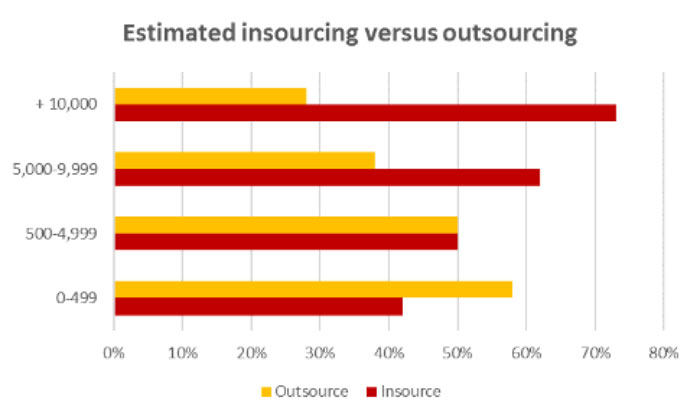
The Goldman Sachs analysis for the American Payroll Association, found that the prevalence of outsourcing decreases as the number of employees increases – refer to the chart below. Larger companies can afford to spend significant sums on payroll systems. Whether cost savings or increased efficiency is obtained is unknown. However, in the in/outsourcing argument this inverse correlation appears to be the only quantifiable fact.

Estimated insourcing vs outsourcing
Estimated insourcing versus outsourcing

Axiomatic Consultants currently provide both insourcing and outsourcing options to clients in 42 African countries and the Covid-19 crisis has furnished us with some interesting and enlightening insights into the in/outsourcing debate.

  • Companies can no longer afford to run payroll platforms that are not cloud-based. In the “next to normal” way of working, which involves remote working, one cannot and should not expect payroll personnel to go to the office because they must log into a server or apply certain updates. This is certainly something that is easily achieved in an insourced model; however, the outsourcing industry does tend to have faster adoption due to the business model relying on technology to increase efficiencies.
  • Many companies are ill equipped to operate remotely which may lead to delays in pay-day or costly mistakes being made. Most outsourced payroll providers have been able to function effectively during the pandemic – contingency planning, backup facilities, and disaster recovery management is a prerequisite risk management tool of such companies. Companies currently outsourcing their payrolls have had the luxury of focussing on their core business during the crisis and have not had to worry about the administrative payroll process.
  • The raft of Covid-19 related legislative changes made by the various African governments was immediate – the measures became effective in the next payroll cycle. Many companies running insourced platforms were not able to make such changes or were perhaps unaware of the changes. Outsourced payroll providers were able to manage these circumstances more effectively due to awareness, a robust process to identify legislative changes, and in-depth tax knowledge.
  • The disruption to normal business during the crisis meant that payroll had to be flexible and be capable of incorporating late changes. Outsourced payrolls have strict submission deadlines which resulted in backdating in subsequent months.

Perhaps the most valuable lesson we learnt was the efficiency obtained where a hybrid model was employed by a company – some payrolls are insourced, while others are outsourced but where all payrolls used a common true cloud technology platform. Where the company experienced problems with an insourced payroll for a myriad reason, this was immediately “transferred” to an outsourcing model. Axiomatic offers both models and we simply took over the running of the insourced payroll until the problem was resolved.

This arrangement is almost like having a free insurance policy, a free put option or a golden parachute which leads to a seamless transition between the two models to ensure employees do not experience any delays to their pay.

Dare we say

– this is like having your cake and eating it.

Payroll Insourcing or Outsourcing Read More »

Outsourced Payrolls

Outsourced Payrolls

Outsourced Payrolls

One solution for a difficult business environment

Outsourced Payrolls

The communication company MTN, which currently operates in 22 African countries, has recently dominated the African media. Last week, the office of the Attorney-General of the Federation of Nigeria charged MTN with arrear taxes of $2 billion. This bombshell came in the wake of the allegations that the company had illegally transferred $8.1 billion out of the country between 2007 and 2015; albeit using authorised financial institutions such as Standard Chartered, Stanbic, Citibank, and Diamond Bank. These recent developments follow the 2015/16 imposition by the Nigerian Communication Commission of fines totaling $5.2 billion for failing to disconnect unregistered SIM cards.

While one cannot immediately contend that MTN is being unjustly targeted, one must take cognisance of the fact that the company’s reputation has been discredited, with the direct result that the share price has collapsed by 72% since September 2014. MTN is however not the only international company that has been targeted in Nigeria:

  • In August 2018, Nigeria’s Consumer Protection Council used the courts to prevent MultiChoice1 from increasing DStv subscription fees by between 5.3% and 7.9%; recognising that the latest inflation rate in Nigeria is 11.1%, which is the lowest level in two years, this does not appear to be an exorbitant increase. The accusation leveled at the company, was that it was attempting to recoup losses made in other African countries.

MultiChoice operates in 49 countries across Africa and is a subsidiary of Naspers.

  • In August 2018, the National Agency for Food and Drug Administration and Control shut down an outlet of Krispy Kreme, alleging that the company was using products that were past their expiry date. The outlet was soon reopened after the authorities concluded that the company was compliant with all relevant health standards.

Surely, a country with declining oil revenues and which emerged from a recession in 2017, would welcome international companies who have invested heavily in them? Surely, a country that is struggling to balance its fiscal deficit would welcome international companies into their tax net? Surely, no country would act in this indiscriminate manner and jeopardise foreign investors’ perception of a stable and business-friendly environment?

While political posturing for next year’s election may be a contributory factor, most African countries (and in particular the oil-producing countries) have crippling debt and rapidly widening fiscal deficits. The result is that much-needed “social spending” cannot occur which in turn leads to dissatisfied and disgruntled voters.

The conventional methodology to balance a budget is to increase taxes, however, several countries have attempted this which has proved unpopular amongst citizens and further exacerbated the levels of voter dissatisfaction.

Example

Kenya, has addressed a revenue shortfall of just over $5.5 billion, by introduced a 16% Value Added Tax on fuel effective on 1 September 2018.

This was not well received and an application to the High Court of Kenya lead to the temporary suspension of the tax. In the 2018/19 budget, it was announced that the excise duty payable by money transfer service providers, would increase from 10% to 12%. Furthermore, MP’s recently rejected plans by the government to legislate that 0.5% of workers’ salaries be paid to the National Housing Development Fund and that a 0.05% tax on bank transactions above KSh 500,000 be levied.

Uganda, Zambia, and Benin have introduced taxes on social media. Uganda also increased the excise duty payable by money transfer service providers from 10% to 15%. Tanzania and Rwanda have introduced capital gains tax on the sale of companies. Ghana proposes to tax the church’s commercial activities and Cameroon has increased the airport tax by a significant 250%.

All these measures are unpopular and result in dissatisfied and disgruntled voters.

As such, international companies are considered a much easier target.

There is a myriad of preventative action plans that an international company can introduce to ensure that they are not unjustifiably targeted by the authorities. One popular action plan adopted by many international companies is to ensure good governance by ensuring that the company’s payroll is run correctly and is compliant with all relevant taxes and statutory deductions.

Many companies are reticent to outsource their payroll and prefer to run them in-house. In our recent article, “Why Should I Outsource my Company’s African Payrolls” we highlighted some of the difficulties experienced by in-house payrolls in achieving compliant status:

Whether the payroll is situated in one African country, or multiple African countries, a different (and higher) level of expertise is required to ensure that the correct tax and statutory deductions are made, as well as the successful implementation of a control mechanism to ensure that these deductions are paid timeously to the relevant authorities.

Managing legislative compliance requires robust policies and procedures along with significant compliance capabilities. Managing the good governance of the company and ensuring it maintains the mantle of a “good corporate citizen” in the country is a vital component of any payroll function. This can best be achieved by using the correct outsourcing partner – simply due to their specialisation and enhanced capabilities in this field.

Further, our article, “How to achieve Legislative Compliance in Pan-African Payrolls” expanded on the inherent risks:

Where the payroll department is processing payrolls in multiple jurisdictions, the problems, and the likelihood of errors, are exacerbated. This risk amplification is crucial given the dictatorial and hard-line attitude adopted by most revenue authorities and should be highlighted as “high-risk” when the compliance audit is conducted. The only method to mitigate such risk, is to complete a comprehensive review of the tax and social contributions embedded within the system. This should be done irrespective of the assurances of the services providers that the said calculations are correct and compliant. This places an onerous burden on companies who do not have the necessary tax expertise available given this is not their core competency.

There is little doubt that outsourcing the company’s payroll is a cogent and effective methodology to guarantee good governance, manage potential reputational risk, and mitigate the possibility of becoming a target of the authorities.

Should you want to know more about Axiomatic’s outsourced service offering in 44 African countries, please

Outsourced Payrolls Read More »

How to achieve Legislative Compliance in Pan-African Payrolls

How to achieve Legislative Compliance in Pan-African Payrolls

How to achieve Legislative Compliance in Pan-African Payrolls

How to achieve Legislative Compliance in Pan-African Payrolls

Currently, there are numerous payroll systems that provide for multi-country payroll processing. While some have better functionality, others are superior in their compliance and alignment to the legislation in the specific African country.

"Compliance is a crucial element and in our opinion trumps functionality and indeed any other considerations."

The standard payroll approach to auditing compliance is usually limited to ensuring that strict segregation of duties within payroll teams is adhered to. It is axiomatic that this compliance check is important; however, of greater importance than the process control, is a comprehensive review of the underlying tax and social contribution calculations embedded within the payroll system. This is aligned with all organisations’ corporate responsibilities.

Any compliance audit must also include a further step. It is of significant importance that the users of the system understand how the calculations are applied. This is especially important when African payrolls are being managed, as often the lack of robustly worded legislation and interpretation notes lead to ambiguity; where the taxability of a specific remuneration component is unclear. If one understands the method of calculation, one can ensure higher degrees of accuracy and compliance.

Where the payroll department are processing payrolls in multiple jurisdictions, the problems, and the likelihood of errors, are exacerbated. This risk amplification is crucial given the dictatorial and hard-line attitude adopted by most revenue authorities and should be highlighted as “high-risk” when the compliance audit is conducted. The only method to mitigate such risk is to complete a comprehensive review of the tax and social contributions embedded within the system. This should be done irrespective of the assurances of the services providers that the said calculations are correct and compliant. This places an onerous burden on companies who do not have the necessary tax expertise available given this is not their core competency.

Some large multinationals rely on a vast and very expensive network of advisors and auditors to mitigate these compliance issues. However, cognizance must be taken of the fact that even though the delegation of the compliance has occurred, the company is still solely responsible to ensure its reputation is intact and to safeguard its status as a good corporate citizen.

One way of managing and concomitantly mitigating this risk is to adopt the following broad process:

The process outlined above may be considered to be costly and overly burdensome, especially where the company has purchased a payroll system from a provider with the assurance that the taxes and social security deductions are accurate. These additional safeguards however pale in comparison when one considers the implications of non-compliance – penalties, interest charges, possible criminal proceedings and the immense reputational damage to the company’s brand in that country.

Reliance on the assurances of the payroll platform provider are not enough; rigorous supplementary procedures must be instituted. Some larger companies may have the skills and competencies internally or within their networks to fulfill this role – for those that do not, Axiomatic is one of the providers who can assist in minimizing this risk to employers.

At the very heart of the payroll function is the accurate and timely withholding of employee’s taxes. This function is imposed on employers in each jurisdiction however these taxes have a direct input into each country’s fiscal health. Therefore, the question arises – is it responsible for a business to see taxes as a cost of doing business, rather than part of a greater social contract with society? It goes beyond just the employer’s responsibility but extends to each and every individual employee of such organisations.

For more information please 

How to achieve Legislative Compliance in Pan-African Payrolls Read More »

Why I should outsource my company’s African Payrolls

Why I should outsource my company’s African Payrolls?

Why I should outsource my company’s African Payrolls?

Why I should outsource my company’s African Payrolls

This is a common question that most international corporates have examined on a regular basis, even more so when it relates to African payrolls. Most out-sourced providers would immediately furnish the following traditional reasons:

Although the achievement of these outcomes is possible, it is often not the case (as explained below). Crucial to the success or failure of the above is the selection of the correct outsourced provider.

Cost-saving is often cited by service providers as the principal rationale to outsource. Cognisance must be taken that the potential cost saving that may be achieved, is based on the size of the employee population, the frequency of changes in the payroll, and the nature of the business. In fact, processing the payroll in-house can be more cost-effective, especially considering that an outsourced provider will still require information to be channeled through to them by a company official whether using an online portal or by other means.

Outsourcing should not aim to do the same job at a lower cost but rather, it must justify itself based on superior value delivery to the company. If the service offering is not superior to what can be provided internally, then why outsource?

Providing an African payroll service whether on an outsourced basis or on an insourced shared service basis is fraught with danger. This is a complex task where the company must ensure that the provider or the shared service department can effectively pay employees, determine and deduct the appropriate taxes and social security obligations, furnish general ledger accounting records, and process year-end tax reporting requirements.

How then can an outsourced payroll truly enhance the company’s competitive advantage directly or indirectly, taking cognizance of the complexity inherent in payrolls on the African continent? The following are some key factors to consider:

Greater access to human capital skills

Human Capital Skills

As with any business, the highest level of skilled human capital is concentrated around that business’ core function. Due to payroll services being the primary focus of an outsourcing business, there is typically a greater level of skill residing in an outsourced payroll provider. This leads to more efficient and effective processes and procedures which in turn, decreases costly errors and creates additional value-add to the company.

In addition, the service model inherent within outsourcing providers means that various divisions have specialized expertise in processing, reviewing, tax, social security, and a myriad other functions – companies, regardless of size, have access to all of these skills. Companies that only have a small number of employees in any country would not necessarily have access to these skills internally.

Greater access to better technology platforms

Payroll and HR systems have become web-based to improve visibility, security and redundancies. Employee self-service and automated claims processes have enhanced and streamlined the previous administratively burdensome manual tasks. An emerging trend is that Payroll and HR systems have merged, into integrated single database solutions which decreases duplication of work and maximizes accuracy.

In essence, payroll technology is moving at an incredibly rapid pace and outsourced providers can leverage such advancements more efficiently. They are able to identify such advancements and new trends in the industry more effectively than companies can.

Outsourced payroll companies are incentivised to ensure that they find technologies and solutions that allow them to better cater to their clients and to reduce processing time to concomitantly, increase their profit margins.

This leads to a better selection and utilisation of technology which drives efficiency for  their clients.

Managing the good governance of the company

When the payroll is situated in one African country, or multiple African countries a different (and higher) level of expertise is required in order to ensure that the correct tax and statutory deductions are made, as well as the successful implementation of a control mechanism to ensure that these deductions are paid timeously to the relevant authorities.

Managing legislative compliance requires robust procedures and policies along with significant compliance capabilities. Managing the good governance of the company and ensuring they maintain the mantle of a “good corporate citizen” in the country is a vital component of any payroll function. This can best be achieved using the correct outsourcing partner – simply due to their specialisation and enhanced capabilities in this field.

Tried and tested data analysis

Business intelligence is an emerging trend and the payroll and HR databases hold a wealth of knowledge which can assist in strategic business decision making. An outsourcing partner that understands this and has the necessary skills and competence to both analyse and contextualise the data, can provide the business with valuable and accurate data to facilitate making these strategic decisions.

A drive to automation and efficiency

Most outsourced businesses work on a per payslip fee and simply put, the profit of the business can only be increased by decreasing the resources required to process the payroll. Thus, the outsourced partner is directly incentivized to maximize the automation and efficiency of,  not just the system but the entire process – this streamlining and automation, in turn, benefits the client company by reducing the time they need to expend on providing information.

A regional capability

The implementation of a single outsourced payroll provider for all African countries is a challenge. However, the competitive advantage which accrues to a company that manages to achieve this lofty objective is great – financial controls are enhanced by having a single payroll provider with one contact and one conduit for cash flow, reporting, and submitting payroll changes – a “One TouchPoint solution”.

The factors mentioned above are naturally not an exhaustive list of reasons to outsource, however, they are the ones that fundamentally add to the companies’ operational efficiency and ultimately their competitive advantage. Each company is different in its make-up and complexity and it is vital that the provider is chosen, is one that both understands this and is flexible enough in their approach to align their service offering to the company’s needs and requirements – and not the other way around.

The outsourcing division of Axiomatic Consultants was formed to address and improve the myriad difficulties experienced when running payroll in multiple African countries. The strategic objective of the company is to provide a world-class, value-added service where every effort is made to customise solutions to address specific needs whilst simultaneously ensuring that such solutions are compatible with and complement the client’s goals, strategy, and business objectives. Every effort is made to ensure that our offering is progressive, innovative, and is designed to furnish our clients with a competitive advantage in their respective industry.

To learn more about what kind of solutions we can offer in this regard, please 

Why I should outsource my company’s African Payrolls? Read More »

COOKIE POLICY

Welcome to our website.

1. Introduction

This Cookie Policy explains how we use cookies and similar technologies on our website axioconsult.com. This policy is designed to help you understand what cookies are, how we use them, and the choices you have regarding their use.

2. What Are Cookies

Cookies are small text files that are stored on your device (computer, tablet, or mobile phone) when you visit certain websites. They are widely used to enhance your online experience by remembering your preferences and actions over time. Cookies are not harmful and do not contain personal information like your name or payment details.

3. How We Use Cookies

We use cookies for various purposes, including:

    • Essential Cookies: These cookies are necessary for the basic functioning of our website. They enable you to navigate our site, use its features, and access secure areas.
    • Analytical/Performance Cookies: These cookies help us understand how visitors use our website. They provide information about which pages are visited most frequently, how long visitors stay on each page, and whether they encounter any error messages. This data helps us improve the performance and usability of our website.
    • Functionality Cookies: These cookies allow our website to remember choices you make (such as your username, language, or region) and provide enhanced, personalised features.
    • Targeting/Advertising Cookies: These cookies are used to deliver advertisements that are relevant to your interests. They may also limit the number of times you see an ad and help measure the effectiveness of ad campaigns.


4. Your Cookie Choices

You have the option to manage your cookie preferences. You can usually modify your browser settings to accept, reject, or delete cookies. Please note that if you choose to block or delete cookies, some features of our website may not function properly.

5. Third-Party Cookies

We may allow third-party service providers to use cookies on our website for the purposes outlined in Section 3. These providers may also collect information about your online activities over time and across different websites.

6. Updates to This Policy

We may update this Cookie Policy from time to time to reflect changes in technology, law, or our data practices. Any changes will become effective when we post the revised policy on our website.

7. Contact Us

If you have any questions about our Cookie Policy or how we use cookies on our website, please contact us.

By continuing to use our website, you consent to the use of cookies as described in this Cookie Policy.