Payroll

Impact of Negative Real Salary Increases on Employees in Africa

Impact of Negative Real Salary Increases on Employees in Africa

Impact of Negative Real Salary Increases on Employees in Africa

Impact of Negative Real Salary Increases on Employees in Africa

Are your employees in some African countries moaning about salaries?

During the annual salary increase cycle, clients often question why inflation is such an important input when determining an equitable salary increase for employees. Inflation plays a crucial role due to its direct impact on the purchasing power of employees. And this is especially important in Africa where a sudden, and often dramatic, increase in inflation is experienced and/or where there is a high prevailing inflation rate.

Granting a negative real salary increase can have dire consequences for employees.

A real salary increase refers to an increase in the employee’s salary that exceeds the rate of inflation, resulting in a higher purchasing power for the individual. In other words, a real salary increase means that after accounting for inflation, the employee has more money to spend on goods and services than they did before the increase.

For example, let’s say you granted an employee a 5% salary increase. If the inflation rate is 2%, then the employee’s real salary increase is 3% (5% – 2% = 3%). This means that their purchasing power has effectively increased by 3% because their salary has grown faster than the prices of goods and services.

Concomitantly, if you grant a negative real salary increase, this results in negative purchasing power which can have several adverse consequences for employees. It can lead to a decrease in their standard of living, as the employee finds it increasingly difficult to afford the same level of goods and services as before. It may also result in financial stress, as employees struggle to make ends meet due to their diminished purchasing power.

Having defined the problem and the consequences of granting a negative salary increase, it is worthwhile considering some African countries with high inflation rates.

What is now patently obvious, is that if you granted employees in the above countries a salary increases this year of less than the “Expected 2024 inflation” shown in the table above, they have received a negative real salary increase and concomitantly, they will experience a decline in their purchasing power.

Of course, other factors must also be considered which could mitigate the erosion of an employee’s purchasing power. However, these factors may also exacerbate the hardship.

For example, in Malawi, the tax tables were amended with effect from 1 April 2024 as detailed in the table below. In a high inflation environment, where we are projecting an average inflation rate of 25.5% for 2024, one would expect the tax bands increases to be correlated with inflation. Without adjusting income tax bands/ brackets and thresholds for inflation, taxpayers may find themselves pushed into higher tax brackets even though their real income hasn’t increased. This results in taxpayers paying a higher proportion of their income in taxes, effectively increasing their tax burden.

For employees earning above MWK 1,800,000, the higher limits will decrease the tax payable monthly and increase their net pay, but it will not compensate them for the erosion in their purchasing power which they will experience because of the high inflation rate and the possible negative salary increase.

While we are not saying that an employer should simply align a salary increase to the expected inflation rate, one must be cognisant of the erosion of employee’s purchasing power in some African countries. And perhaps most importantly, understand why they are moaning.

Impact of Negative Real Salary Increases on Employees in Africa Read More »

Payroll Integration using API’s

Payroll Integration using API’s

Payroll Integration using API’s

Payroll Integration using API’s

In the past, payroll was considered a “legacy sector” – a sector stubbornly resistant to change and dismissive of any innovation. Concomitantly, payroll was no more than an administrative function using outdated technology, incorporating a raft of manual processes, which in turn made strategic data reporting impossible. How things have changed.

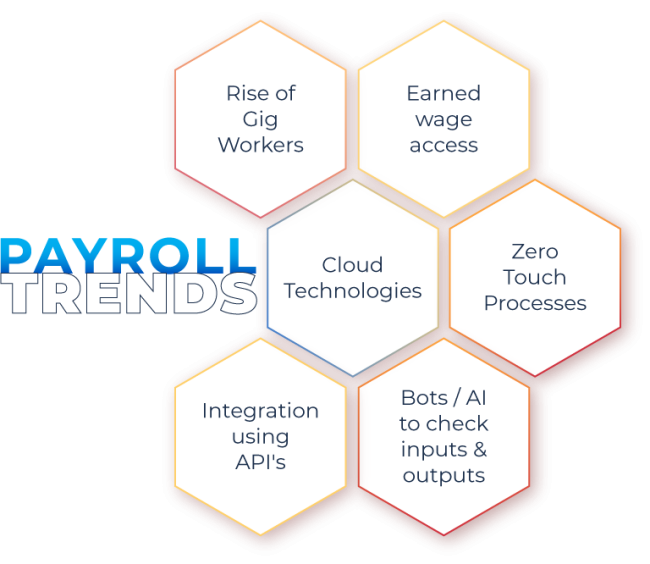
Over the last few years, payroll has been capitulated forward to incorporate and embrace disruptive technology, and automation, and is now recognised as a strategic system because of the value of the data it houses. Some of the major latest trends are:

axiomatic-intergrations-payroll-trends-24
In this article, we will concentrate on integrations and benefits that companies can obtain with APIs.

Our Approach to Integration

Axiomatic has significant experience integrating with other systems using Application Programming Interface (“API”) including the development and set-up of appropriate middleware. Previous interface projects have ranged from rather simple interfaces to custom-built solutions with a complete staging area with two bridges between various systems to ensure the data was “cleansed” and coupled with update logging, data quality validation, and consistency.

Using API functionality, as well as middleware, Axiomatic can integrate with most systems which ensures the shift from transactional human capital management (HCM) to end-to-end experiences which improve the Employee Value Proposition while simultaneously ensuring data accuracy and security.

Globally there is a drive for both efficiency and the automation of procedures by utilising integration between the HRIS system, other related systems, and the payroll platform. This is easily achieved in more developed countries – however, Africa has always presented a challenge due to the lack of technology, outdated IT infrastructure, and multi-country coverage.

Axiomatic Consultants Payroll Services
We can now offer true integration in 44 African countries.
Axiomatic utilises the Payspace payroll platform which is a true cloud-based system, it is ISO27001 certified, single instance and the uniformity in set-up across countries reduces the costs in integration due to the ability to globally map templates. In addition, we guarantee full legislative delivery in all 44 African countries.

This powerful payroll functionality combined with pivotal middleware enables companies of all sizes to overcome data silos by creating powerful Applications, Data, and API integration on-premise and in the Cloud, from a single interface.

System Overview

Full system specification available on request.

User Interface

The custom user interface allows traditional long-standing payroll protocols to still be followed while not losing the efficiency gained by interfacing. Our methodology retains the ability for payroll resources to maintain strict audit controls developed over many years to ensure proper review of data and proactively manage changes between systems. Productivity and leveraging technology may be the order of the day but one can never downplay the importance of key internal audit controls of a finance-related process.
A full user Manual is available on request.

Why use Axiomatic?

We are an independent company that specialises in furnishing a diverse range of services relating to employee benefits, strategic remuneration consulting, strategy consulting, and payroll services in Africa.

In any API integration implementation project, the role of a Payroll Business Analyst is pivotal in ensuring smooth collaboration with third-party developers. The Business Analyst serves as a liaison between the payroll system stakeholders and the developers, bridging the gap between technical requirements and business needs.

Initially, the Business Analyst works closely with stakeholders to understand the existing payroll processes, identify pain points, and define the objectives of the integration project. They gather and document detailed requirements, ensuring clarity and alignment with business goals.

In collaboration with third-party developers, the Business Analyst translates these requirements into technical specifications, outlining the data exchange protocols, security measures, and system architecture needed for seamless integration. Throughout the development process, they facilitate communication, address any discrepancies or challenges, and ensure that the final solution meets the specified criteria.

Moreover, the Business Analyst plays a crucial role in testing and validating the integration, working with developers to conduct thorough quality assurance checks and user acceptance testing. They also provide ongoing support post-implementation, monitoring system performance, troubleshooting issues, and facilitating any necessary adjustments or enhancements.

Ultimately, the relationship between the Payroll Business Analyst and third-party developers is characterized by collaboration, communication, and a shared commitment to delivering a robust, efficient, and tailored API integration solution that optimizes payroll processes and enhances business operations.

Payroll Services

Additional information regarding our African payroll offering

Conclusion

There can be little to no doubt that integrations are the future of the industry. Our experience and acumen extend to Workday, SuccessFactors, SAP, and a multitude of other systems including Time and Attendance and/or Finance systems.

With our extensive expertise in both African payrolls and powerful technology and tools, we truly believe we can deliver a single scalable solution for your integration environment in Africa.

If you would like to discuss integrations with us, please:

Payroll Integration using API’s Read More »

Emerging Markets Payroll (EMP)

Emerging Markets Payroll (EMP)

Emerging Markets Payroll (EMP)

Emerging Markets Payroll (EMP)

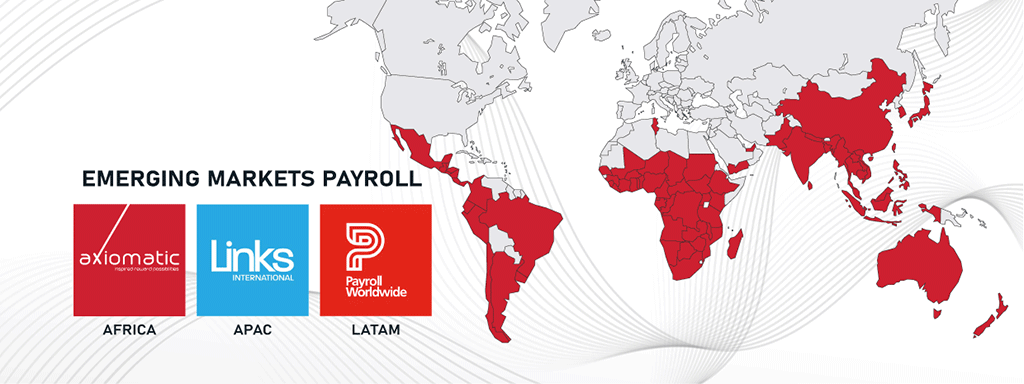
Axiomatic is excited to announce that we have formed a payroll alliance that extends our coverage of 43 African countries, now includes an additional 37 emerging market countries.

Emerging Markets Payroll (EMP) is a payroll alliance of three specialist Regional Payroll Providers that collectively offer comprehensive payroll support for 80 countries in emerging markets across Africa, Asia Pacific, and Latin America.

Our alliance partners are:

Links International – the company was established in 1999 and provides services across the Asia Pacific region in 20 countries.

Payroll Worldwide – the company was established in 2007 and provides coverage in Latin America in 14 countries.

At EMP, our team of 320+ is committed to streamlining and simplifying your payroll processes in emerging markets using secure cloud-based technology. Further, EMP’s ability to integrate with leading HCMs including Workday, SuccessFactors, and Oracle HCM will ensure a seamless journey for your business.

Elevate Your Role with EMP's Payroll Outsourcing Services

Looking for a payroll provider who knows the ropes? Axiomatic EMP Services helps you save time and cut costs. Get in touch today for a free consultation.

Emerging Markets Payroll (EMP) Read More »

Africa: 2023 Inflation and Salary Increase

Africa: 2023 Inflation and Salary Increases

Africa: 2023 Inflation and Salary Increases

Africa: 2023 Inflation and Salary Increase

Africa Salary Increases

Salary increases are inescapably linked to inflation; where inflation is one of the most important determinants when deciding on the amount of the salary increase. Other factors must also be taken into consideration such as financial constraints of the employer, growth rates in the country and general market and/or economic conditions.

The next consideration is to determine a “real increase”. A real increase is defined as the increase after inflation has been considered. As an example, if the salary increase is 6.0% and inflation is 5.0%, then a 1.0% real increase has been granted.

Future inflation is usually employed as this more accurately compensates the employee for the expected ravages of inflation and the negative effect on their purchasing power in the new year- rather than historic inflation.

While this is undoubtably the correct methodology to derive a scientifically formulated salary increase which is equitable to all stakeholders, inflation forecasting errors do occur. Inflation in African countries is notoriously difficult to predict for the primary reason that it is extremely sensitive to two important drivers namely, local currency and food prices. The foreign exchange markets in African countries are illiquid and thus any depreciation in the currency tends to be over exaggerated with the consequence of higher imported inflation. Further, food prices are constantly influenced by bad harvests and adverse weather conditions.

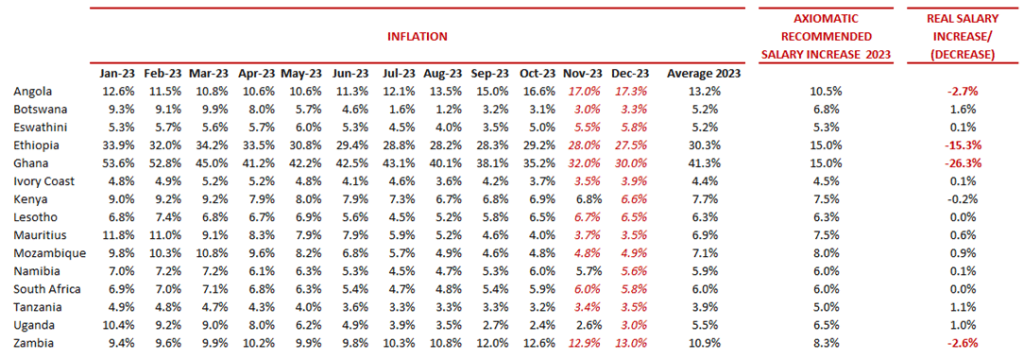
Given this, before one commences with the new salary increase exercise, it is prudent to look in the rear-view mirror to ascertain the actual “real salary increases” employees received the previous year. In the table below we have calculated the average 2023 inflation rate for selected countries, together with the Axiomatic recommended salary increase for 2023 which we suggested in January 2023. The final column displays the real salary increase or decrease:

Represents Axiomatic’s forecast

Clearly, employees in Ethiopia and Ghana received a significant negative real increase in 2023. Employees in Angola and Zambia were also negatively affected by unexpectedly high inflation albeit to a lesser extent.

While the normal practice is not for the employer to “make good” the negative real salary increase in 2024, cognisance should be taken of the erosion of the Ethiopian and Ghanian employee’s net pay in 2023, if possible.

About Axiomatic

Axiomatic currently runs both insourced and outsourced payrolls in 44 African countries on a cloud-based platform that is ISO27001 accredited.

In addition, we have significant experience integrating the payroll platform with SuccessFactors, Workday, and other related systems.

Should you wish to know about our offering, please:

Africa: 2023 Inflation and Salary Increases Read More »

Africa: January 2024 Employee Tax Changes

Africa: January 2024 Employee Tax Changes

The fiscal year of several African countries is from January to December. Consequently, a raft of legislation is promulgated at the end of each calendar year which becomes effective on 1 January of the following year, and which affects the tax deducted from employees and/or changes the cost of employment for employers.

Below we have highlighted changes, effective 1 January 2024 in the following countries:

TOGO - Universal Health Insurance

On 11 October 2023, The Council of Ministers, under the chairmanship of the President of the Republic adopted seven decrees which would in effect accelerate the process of implementing universal health insurance. The universal health coverage aims to achieve equal access to essential or primary health care for all. The Government aims to complete the rollout of the universal health system by 2025.

The proposals that will impact the Client’s payroll include the following:

    • The contribution base for salaried workers is the basic salary and all taxable bonuses and allowances, excluding reimbursements of expenses and family benefits.
    • The amount of remuneration used as the basis for calculating the contributions cannot be lower than the Guaranteed Interprofessional Minimum Wage (SMIG) which is currently fixed at 52.500 CFA per month.
    • It is important to note that if a worker is employed by several employers, each of them is responsible for the payment of the calculated share of contributions in proportion to the remuneration he pays to the person concerned.
    • Contribution rate: The contribution rate is set at 10% of the monthly remuneration, of which at least 50% is payable by the employer and the remainder is payable by the employee.
PAYROLL IMPACT

The deduction towards Universal Health Insurance will add a burden to the employee and it will also be an additional cost to the employer.

ANGOLA - Tax Table Changes 2024

The General State Budget (OGE) for 2024 was approved by the National Assembly on 13 December 2023 and enacted on 26 December 2023. The amendments to the 2024 Economic Year (OGE-2024) appear in Law No. 15/23, of 29 December 2023 (OGE-2024 Law), and in all its annexes. The Law, and concomitantly the changes to payroll, are effective from 1 January 2024.

Article 20 amends the Employment Income Tax Code (Imposto sobre os Rendimentos do Trabalho) and will affect employee’s taxes as follows:

    • Income earned up to a limit of Kz 100,000 per month is now exempt from IRT. Previously the zero-rated bucket was set at Kz 70 000 per month.
    • The old tax brackets have been amended for the 2024 tax year- refer to the table below.
    • The 10% bracket of Kz 70 000 to Kz 100 000 is removed.
New Tax Tables for 2024
PAYROLL IMPACT

The changes to the tax table will provide some relief to employees at all levels of income.

However, cognizance should be taken of the fact that Angola has experienced high inflation over the second half of 2023 (refer to the graph below) which will have eroded employees purchasing power. Any reduction in taxes paid in 2024 will therefore be a welcome relief.

IVORY COAST - Tax Changes 2024

The Presidency of the Republic published ‘Ordonnance No 2023-179 du 13 September 2023″ which will take effect on 1 January 2024. The consequence of the Ordinance is a comprehensive reform of the calculation of personal taxes relating to salary, wages, pensions, and life annuities. The reform is the result of suggestions by the IMF which stated that the previous “… personal income tax regime is complex and regressive”.

Previously, ITS comprised of three different taxes which were payable by the employee, namely:

    • IS (Tax on Salary/Wages) which was 1.5% of 80% of taxable employment income.
    • CN (National Contribution) which was taxed at progressive tax tables based on 80% of taxable employment income, and
    • IGR (General Income Tax) which was calculated using a specific formula and progressive tax tables, taking into consideration the employee’s family situation.


The ITS reform consists of the following:

    • Merging the three taxes payable by the employee (IS, CN, and IGR) into one single payroll tax.
    • Adopting a progressive tax table (which will consist of 6 brackets).
    • Instituting a tax reduction/credit mechanism for dependents to replace the family quotient, to consider the employee’s family situation. For example, if the employee is:
      • Single, divorced, or widowed with no children, will have 1 share,
      • Married individuals with no children, single or divorced individuals with one dependent child will have 2 shares,
      • These values will increase with 0,5 shares for each additional dependent child limited to 5 shares, or it will increase with 1 for each disabled minor or adult dependent child.
    • Establishing a zero-rate tax bracket for monthly taxable employment income less than 75,000 francs per month.
    • Increasing the monthly exempt portion of retirement pensions and life annuities from 300 000 francs to 320 000 francs.
    • Reducing tax on retired employees over 70 years of age, by reducing the tax with an abatement of 75%.
    • The standard abatement/deduction of 20% will be repealed and the progressive tax tables will be applied to 100% of the taxable employment income.
New Tax Tables for 2024
Tax Rebate Table for Family Charge 2024
PAYROLL IMPACT

In general, most employees will experience a small increase in net take-home pay. Some employees will experience slightly higher taxes and concomitantly, lower take-home pay. This will depend on the number of dependents which is applied to the above Tax Rebate for Family Charge table.

ZAMBIA - Tax Table Changes 2024

The 2024 Budget Address was enacted on 26 December 2023 and thus the legislation and the impact on payroll will become effective on 1 January 2024.

Limited changes were made to the tax tables:

    • The exempt threshold has increased from K4 800.00 to K5 100.00 per month.
      • This represents an increase of 6.25% which is disappointing given that inflation in November 2023 was 13.1%.
    • The marginal tax rate for the highest income bracket has been reduced slightly from 37.5% to 37.0%.
Annual Tax Table
PAYROLL IMPACT

The increase in the exempt threshold as well as the reduction of the highest income tax bracket will benefit all employees, and their net income will increase marginally.

NAPSA Ceiling Increase 2024

The National Pension Scheme Authority is mandated to review the contribution ceiling and pension payments annually and adjust them in line with any change in the National Average Earnings (NAE).

This is in accordance with Section 35 of the National Pension Scheme Act No 40 of 1996. The NAE figure for 2024 has increased to K7,454.00 from K6,710.00 in 2023 as determined by the Zambia Statistics Agency.

Accordingly, on 4 January 2024, the National Pension Scheme Authority advised that the maximum monthly employee contribution for the year 2024 has been revised to K1,490.80 from K1,342.00- an 11% increase. Given that the employee and employer both contribute 5%, the maximum total monthly contribution will increase to K2,981.60.

    • The contribution rate remains unchanged at 10% of an employee’s monthly gross earnings; and
    • For NAPSA purposes, earnings refer to any benefit given by an employer in exchange for the employee’s service. Earnings therefore include basic salary, bonuses, commission, severance pay, overtime allowance, leave allowance, acting allowance, and commuted leave days.
PAYROLL IMPACT

The upward adjustment to the ceiling will increase the contributions of most employees and concomitantly have a direct impact on their net pay.

NIGER - ANPE Contribution Increase

Currently, employers are required to pay 0.50% of the employee’s social security base to the Agence Nationale pour la Promotion de l’Emploi (the Employment Promotion Agency or ANPE). This government organisation is responsible, among other things, for jobseeker placements and contribution to the development and implementation of a national employment policy, through the implementation of programmes of integration and reintegration of the unemployed

In accordance with Decree No. 2023-258/P/CNSP/MFP/T/E of November 3, 2023, which modified and supplemented Decree No. 2002-277/PRN/MFP /T of November 29, 2002, employers in the para-public and private sectors are informed that the rate of the employer contribution has increased from 0.5% to 1% of the payroll, from 1 January 2024.

The contribution is recovered by the National Social Security Fund (CNSS) according to the same terms as social contributions.

PAYROLL IMPACT

This contribution is only made by employers and as such, there will be no impact on employees. It will however increase the employment cost for companies.

About Axiomatic

Axiomatic currently runs both insourced and outsourced payrolls in 44 African countries on a cloud-based platform that is ISO27001 accredited.

In addition, we have significant experience integrating the payroll platform with SuccessFactors, Workday, and other related systems.

Should you wish to know about our offering, please:

Africa: January 2024 Employee Tax Changes Read More »

African Payroll: DRC Inflation & 2024 Salary Increases

African Payroll: DRC Inflation & 2024 Salary Increases

African Payroll: DRC Inflation & 2024 Salary Increases

African Payroll: DRC Inflation & 2024 Salary Increases

The Democratic Republic Of Congo (DRC) has a significant dollarized economy which is a legacy of extremely high inflation during the rule of Mobutu Sese Seko. Like Zimbabwe and some other African countries, US dollars are accepted in restaurants and shops and big-ticket-item purchases are usually made in US dollars. Estimates of the degree of financial dollarization in the economy are around 90%.

Given the dollarisation of the economy, the rapid depreciation of the currency, the Congolese Franc (CDF), from May 2023 is of grave concern.

US$ to CDF: 1 YEAR

Despite the currency depreciation, we remain relatively bullish on growth in the DRC as evidenced by the table below. This is relatively good news for future corporate profits.

HISTORIC AND PROJECTED DRC REAL GDP

2018
5.8%

2019
4.4%

2020
1.7%

2021
6.2%

2022
8.9%

2023 (*)
6.5%

2024 (*)
6.4%

* Represents Axiomatics’ forecast

While growth is expected to remain relatively strong, the economic theory postulates that a depreciating currency, exacerbated by a highly dollarized economy, must lead to higher inflation- and this is exactly what has transpired. The graph below clearly illustrates that inflation has moved significantly higher during the first half of 2023.

As Comp and Benefit practitioners are acutely aware, one of the most important inputs into the salary increase decision is the projected future inflation. While it must be acknowledged that there is no generic or standard methodology in Africa where one can state that the salary increase would be a real increase of, for example, 1.0% (the projected future inflation rate plus 1.0%) – one must accept that high inflation typically does concomitantly mean higher salary increases. Such salary increases must be tempered by the financial affordability of the company and the macroeconomic environment of the specific country.

DRC salary increase forecasts for 2024 are therefore extremely difficult to estimate.

The central bank has tightened monetary policy significantly. At the 8 August 2023 meeting, the policy rate was increased by 14.0% to 25.0%- the highest level in over a decade. The rationale for the extraordinary increase was justified because of the “… accentuation of pressures on the exchange rate and inflation”.

One will have to wait for more incoming inflation data to gauge whether the August 2023 draconian policy rate increase and the tightening of monetary policy, arrest the upward inflation trajectory and reduce the inflation rate in 2024.

However, employers should budget for significantly higher salary increases for 2024 than those granted in 2023.

The caveat to the above assertion is that higher salary increases in 2024 would only apply to employees being paid in CDF. Local employees being paid in US$ would have experienced an increase during the year to date of 28% in their local purchasing power due to the exchange rate having depreciated from 2,050 to 2,625- less of course, the applicable inflation rate.

A further action that employers can consider, is to ensure that employees are enjoying all permissible allowances and exempt income, in accordance with the applicable legislation and tax regulations. These exempt or partially exempt items include inter alia:

    • Pension contributions
    • Housing allowance: for a value not exceeding 30% of gross salary.
    • Transport allowance
    • Family allowance
    • Telephone charges (professional use)
    • Home leave for assignee and family
    • Business trips
    • Medical charges

About Axiomatic

Axiomatic currently runs both insourced and outsourced payrolls in 44 African countries on a cloud-based platform that is ISO27001 accredited.

In addition, we have significant experience integrating the payroll platform with SuccessFactors, Workday, and other related systems.

Should you wish to know about our offering, please:

African Payroll: DRC Inflation & 2024 Salary Increases Read More »

COOKIE POLICY

Welcome to our website.

1. Introduction

This Cookie Policy explains how we use cookies and similar technologies on our website axioconsult.com. This policy is designed to help you understand what cookies are, how we use them, and the choices you have regarding their use.

2. What Are Cookies

Cookies are small text files that are stored on your device (computer, tablet, or mobile phone) when you visit certain websites. They are widely used to enhance your online experience by remembering your preferences and actions over time. Cookies are not harmful and do not contain personal information like your name or payment details.

3. How We Use Cookies

We use cookies for various purposes, including:

    • Essential Cookies: These cookies are necessary for the basic functioning of our website. They enable you to navigate our site, use its features, and access secure areas.
    • Analytical/Performance Cookies: These cookies help us understand how visitors use our website. They provide information about which pages are visited most frequently, how long visitors stay on each page, and whether they encounter any error messages. This data helps us improve the performance and usability of our website.
    • Functionality Cookies: These cookies allow our website to remember choices you make (such as your username, language, or region) and provide enhanced, personalised features.
    • Targeting/Advertising Cookies: These cookies are used to deliver advertisements that are relevant to your interests. They may also limit the number of times you see an ad and help measure the effectiveness of ad campaigns.


4. Your Cookie Choices

You have the option to manage your cookie preferences. You can usually modify your browser settings to accept, reject, or delete cookies. Please note that if you choose to block or delete cookies, some features of our website may not function properly.

5. Third-Party Cookies

We may allow third-party service providers to use cookies on our website for the purposes outlined in Section 3. These providers may also collect information about your online activities over time and across different websites.

6. Updates to This Policy

We may update this Cookie Policy from time to time to reflect changes in technology, law, or our data practices. Any changes will become effective when we post the revised policy on our website.

7. Contact Us

If you have any questions about our Cookie Policy or how we use cookies on our website, please contact us.

By continuing to use our website, you consent to the use of cookies as described in this Cookie Policy.